
How we used AI FDE to vibe-code a production WhatsApp CRM on Palantir Foundry. In 6 weeks.
A Digital Health company had 100,000+ people signing up for free workshops. Thousands of WhatsApp conversations. And a sales team drowning in fragmented tools.
Six weeks later, average response times dropped from hours to seconds, the team had a unified AI-powered messaging hub, and the platform was already expanding beyond sales into customer support.
This is how we built it. And why it took weeks, not months.
The problem nobody talks about
Everyone focuses on lead generation. This company was great at it. 100K+ registrations, massive workshop attendance, strong brand. The funnel was full.
But the funnel was leaking.
- Sales reps used personal WhatsApp accounts, each working in complete isolation with no visibility over sent messages and limited ability for leadership to steer direction
- No shared view of who said what. No conversation history across the team
- One rep might call a lead who'd already had a 30-message exchange with another rep. Zero context about it
- The CRM had basic contact data, but nobody checked it mid-conversation
- High-ticket program (annual subscription). High trust required. Low conversion delivered
The core issue wasn't the product, the marketing, or the team. It was that every customer conversation happened in a silo. Nobody could see the full picture.
The bet: coaches first, sales second
Before writing a single line of code, the client made a bold strategic call: stop selling directly.
Instead of reps cold-calling leads, health coaches would engage first. One centralized WhatsApp number. Real relationships. Personalized health assessments. A structured nurturing journey that felt like care, not pipeline management.
Sales reps would only enter when the lead was already warm. Already trusted the coach. Already experienced the value. Already showing genuine buying signals.
In practice, this meant a structured journey:
- Lead enters through a marketing event → contacts the central WhatsApp number
- Coach engages: builds a genuine relationship, answers questions, shares relevant content
- Personalized assessment: AI-powered health analysis shared directly in the chat
- Content & education: coaches share testimonials, relevant videos, and workshop session previews
- AI detects buying signals: the system scans conversations and flags readiness
- Handoff to closer: the lead has already built trust with a coach, experienced the value, and shown purchase intent
This wasn't a technology decision. It was a process redesign. But it needed a platform to make it work at scale.
That platform didn't exist. So we built it.
Why 6 weeks, not 6 months
Here's what would normally take months:
- Custom messaging UI with real-time sync, native audio/image support, and auto-transcription of voice messages
- Data pipelines and Ontology design across 10+ interconnected data sources
- AI assistant with full conversation context and buying signal detection
- Automated image analysis pipeline with in-chat results and one-click sharing
- Enterprise security with role-based access control
- Mobile-responsive design with custom component rendering
We delivered all of it. Dozens of production features. Six weeks. Here's why that was possible and why it would have taken anyone else six months:
1. AI FDE: vibe-coding the full stack
The application was built using Palantir's AI-powered Foundry Development Environment (AI FDE). And not just the frontend.
AI FDE accelerated development across every layer:
- React frontend: describe what the UI should do. The AI generates production-quality code. That three-column layout with filters, real-time updates, embedded media, and native voice memo playback? Vibe-coded.
- Data pipelines: ingestion from WhatsApp, Sales CRM, Marketing CRM, engagement platforms. AI FDE helped build and iterate on the medallion architecture and data mesh feeding the Ontology. Fast iteration cycles, not week-long pipeline debugging.
- Ontology design: 10+ interconnected Object Types powering the entire application. AI FDE scaffolded and refined the relationships. What normally takes careful, manual modeling got compressed into hours.
Engineers focused on architecture decisions and integration strategy. AI FDE handled the velocity.
2. OSDK: no backend to build
Traditional approach: design a database schema, build a REST API, write integration logic, maintain it all. Months of work. And that's before the frontend even starts.
With OSDK (Ontology SDK for React), the frontend talks directly to Foundry's Ontology. No custom API layer. No database to design. Define objects, relationships, and actions once in Foundry. The React app queries them natively.
This killed an entire engineering layer. The data model? Already there. The API surface? Already there. We just built the experience on top.
3. Foundry: infrastructure you don't build
Authentication, permissions, data pipelines, streaming, deployment. All handled by the platform. We didn't build a security layer. We didn't build a data pipeline. We didn't build a deployment system. We configured one.
The combination of AI FDE + OSDK + Foundry's infrastructure means: what you'd normally staff a 5-person team for 4-6 months to build, we shipped with a lean team in 6 weeks. That's not a minor efficiency gain. That's a different model of software delivery.
See it in action
We built the interactive demo below to give you a feel for what the platform looks like in practice. It's not the production application — it's a purpose-built showcase that highlights many of the key integrations and capabilities we implemented for our client, so you can understand the experience visually and quickly.
Explore the demo below. All data shown is notional — but every feature you can click represents a real production capability.
What to try first (60 seconds)
- Read the AI Summary at the top of the chat — it distills the full conversation into one actionable insight: Maria's objection is price, and the recommended next step is clear
- Notice the voice transcripts — voice memos in the chat show a waveform player with a full text transcript underneath, so coaches can scan content without listening
- Click "Alex R." in the sidebar (3 unread messages) — notice how the urgency is immediately visible. Three questions, zero replies. This lead is slipping
- Try the filters — select "Leads" from the Segment dropdown. The list narrows from 12 to 8. Add "Needs Reply" from Status. Now you see only the leads waiting for a response
- Send a message — type anything and press Enter. Notice the WhatsApp-style delivery and read receipts
- Click "Lead Assistant" — see Thomas K.'s nurturing checklist (71% complete), event history, AI-extracted key facts, and a direct CRM link. This is what the coach sees instead of checking 3 separate tools
- Browse the video library & testimonials — click the "Videos" and "Testimonials" sub-tabs inside Lead Assistant. Coaches use these to share relevant content mid-conversation, a key part of the nurturing journey
- Click "AI Assistant" — try "What is the recommended next step?" or "What is their biggest success blocker?". The AI has access to full conversation history and lead profile, and responds with actionable recommendations
That's the coach-first model in 60 seconds. A coach can triage their inbox, understand a lead's full history, and hand off to a closer — all without leaving the conversation.
What you're looking at
- Conversation Inbox — prioritized by urgency with dynamic filters (assignee, segment, event, status) and live search
- Chat Thread — text, images, voice memos (waveform + transcript), and animated message delivery
- Lead Assistant — unified profile with nurturing checklist, events, key facts, and CRM context
- AI Assistant — pre-built questions, buying signal detection, and filterable video library
- Performance Dashboard — time-range analytics with per-coach KPIs and activity feed
Under the hood
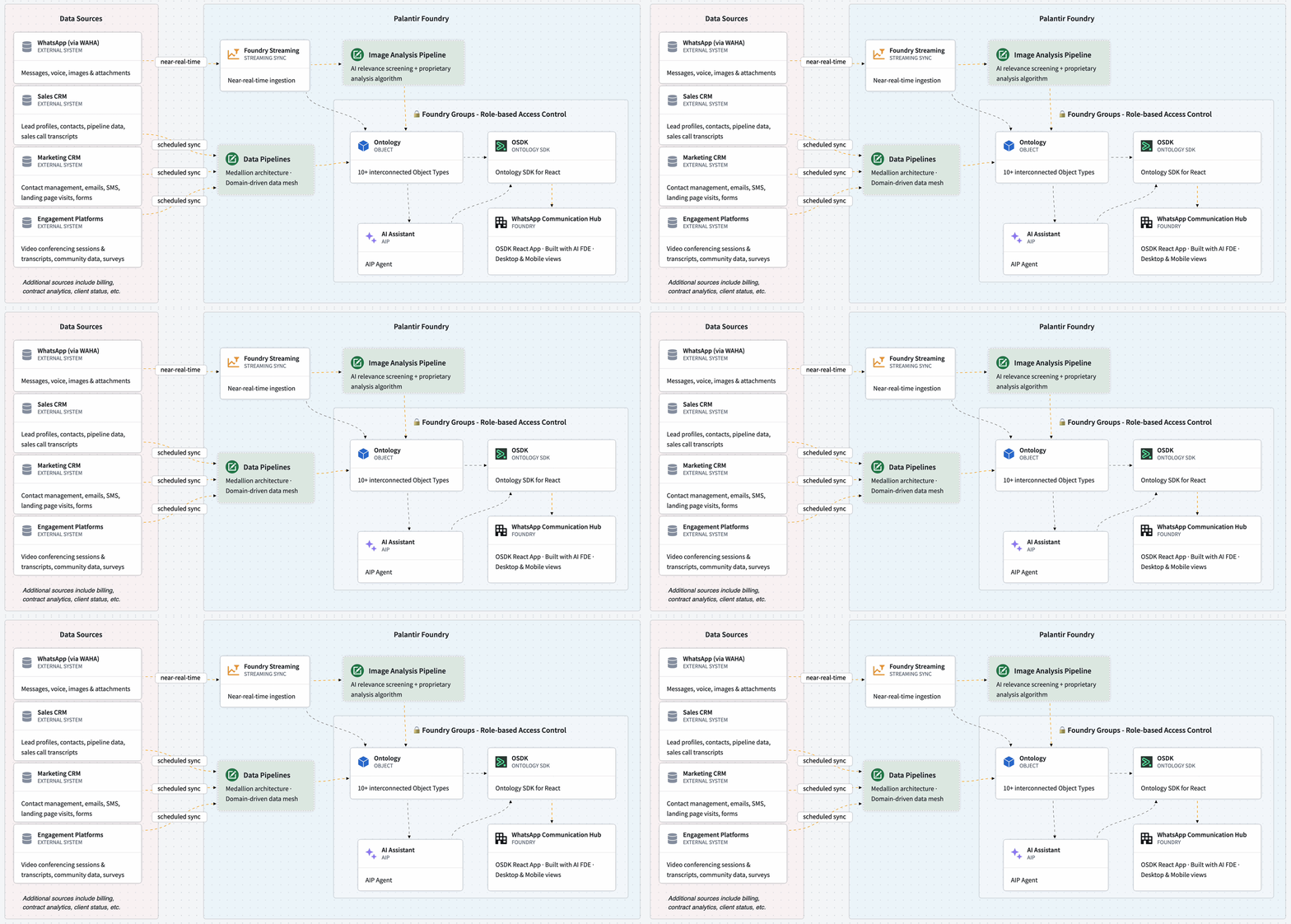
The stack
| Layer | What | Why it matters |
|---|---|---|
| Messaging | WAHA (open-source) | Full WhatsApp API control without vendor lock-in |
| Data Pipelines | Medallion architecture, domain-driven data mesh | Raw data from 10+ sources transformed through bronze → silver → gold layers |
| Data Model | Foundry Ontology (10+ Object Types) | Single source of truth for every entity in the system |
| API | OSDK for React | Frontend queries the Ontology directly. No REST API to build or maintain |
| Frontend | React, vibe-coded via AI FDE | WhatsApp-level fidelity, built at 10× speed |
| AI | AIP Agent (via Agents API) | Contextual assistant with access to full lead history |
| Image Analysis | AI relevance screening + proprietary AI/CV algorithm | Two-step pipeline: screens for relevance, then processes via proprietary AI |
| Security | Foundry Groups | Role-based access: add a team member to a group, they're in. No code changes |
The hard parts
Every project hits a wall where you either solve the real problem or ship a polite workaround. We hit four.
Near-real-time on a platform that isn't real-time
Foundry's standard batch processing pipeline with Ontology indexing introduces a delay of a few minutes. For analytics dashboards, that's fine. For a messaging app where a coach is mid-conversation and waiting for confirmation that their message actually sent? Completely unusable.
We implemented Foundry Streaming. Not as a workaround. As the architecture. WhatsApp messages arrive through WAHA, stream through Foundry's real-time pipeline, and surface in the UI within seconds.
The result: a coach sends a message, the conversation updates instantly. No refresh buttons. No "your message is being processed" spinner. Real-time messaging on top of an enterprise data platform.
Unified lead context from 10+ data sources
A lead walks in. The coach needs to know: Have they attended workshops? Which ones? Did they complete a health assessment? What did the AI extract from their call transcripts? Are they in a current program? What do the CRM notes say?
That data lives scattered across 10+ Ontology Object Types. Lead profiles, messages, call transcripts, marketing offers, program enrollments, assessments, AI-extracted facts. Normally, a coach would context-switch between three or four tools to piece this together. Or more likely, they wouldn't bother.
We built a single OSDK function that aggregates everything into one contextual response per lead. Open a conversation. See the full story. Engagement history, health data, call summaries, AI insights. Zero tab-switching.
AI that actually helps (not just summarizes)
The AI assistant isn't a chatbot bolted onto a messaging app. It's an AIP Agent with deep access to the full conversation history, lead profile, CRM data, and AI-extracted key facts.
Coaches get pre-selectable questions built for the actual workflow:
- "What is this person's core motivation?"
- "What is their biggest success blocker?"
- "What is the recommended next step?"
But here's the part that actually moved the needle: buying signal detection. The AI scans conversations and detects when a lead mentions pricing, asks about program details, or uses language that signals readiness. When it detects a hot lead, it immediately notifies the assigned closer.
Closers stop scrolling through 200 conversations hoping to spot warmth. The system tells them who's ready. And why.
Automated image analysis inside the chat
Two-step pipeline, embedded directly in the messaging flow. First: an AI prompt screens incoming images to determine relevance (is this a meaningful submission, or just a random photo?). If relevant, a scheduled pipeline routes it through a proprietary AI/CV algorithm that generates visual results for the coach.
Those results show up alongside the original image. Same conversation panel. No downloads, no re-uploads, no "please send this to our other tool." Background processing. Minutes. Zero manual effort.
Scope: what we shipped in 6 weeks
- Conversation Management: real-time sync, native voice memos, audio transcription, templated responses via slash commands
- Lead Intelligence: unified context from 10+ data sources with editable fields and CRM deep links
- AI Features: contextual assistant, key facts auto-extraction, buying signal detection with closer notifications
- Automated Image Analysis: AI-powered pipeline embedded directly in the chat flow
- Team Workflows: labeling system, group-based access control, role-specific views (coach, closer, admin)
- Content Sharing: video library with tracking links, testimonial distribution
- Native Mobile View: fully responsive design optimized for on-the-go coaching and sales conversations
- Infrastructure: WhatsApp integration via WAHA, near-real-time streaming, cost optimization
All shipped. All in production.
The results
| Metric | Before | After |
|---|---|---|
| Avg. response time | Hours (reps checking personal phones between tasks) | Seconds with centralized inbox and priority routing |
| Lead context at first touch | Scattered across 3-4 tools, often skipped | Full history in one view: conversations, assessments, CRM data, AI insights |
| Coach satisfaction | Constant app-switching, manual tracking | Single workspace with AI assistance and automated workflows |
| Visibility for leadership | Zero oversight of conversation quality or volume | Real-time dashboards with per-coach KPIs and activity feeds |
| Platform expansion | Sales only | Extended to customer support operations |
The shift from isolated personal WhatsApp accounts to a unified platform changed how the team works day-to-day. Coaches spend less time searching for context and more time building relationships. Leadership can identify bottlenecks and coach performance without requesting manual reports. The system proved valuable enough that the client expanded it beyond sales into customer support within weeks of launch.
Key takeaways
1. The biggest improvements didn't come from the technology. They came from the decision to let coaches lead and sell second. Technology without process redesign would have been a faster way to do the same broken thing.
2. An Ontology-first architecture eliminates integration debt. Each new feature we added took less time than the one before it, because every capability shared the same data foundation.
3. AI FDE makes AI-assisted development production-ready at team scale. This isn't a demo. Thousands of conversations daily in production, built by three engineers in six weeks.
Building something similar? We'd love to hear about it. Book a discovery call →